
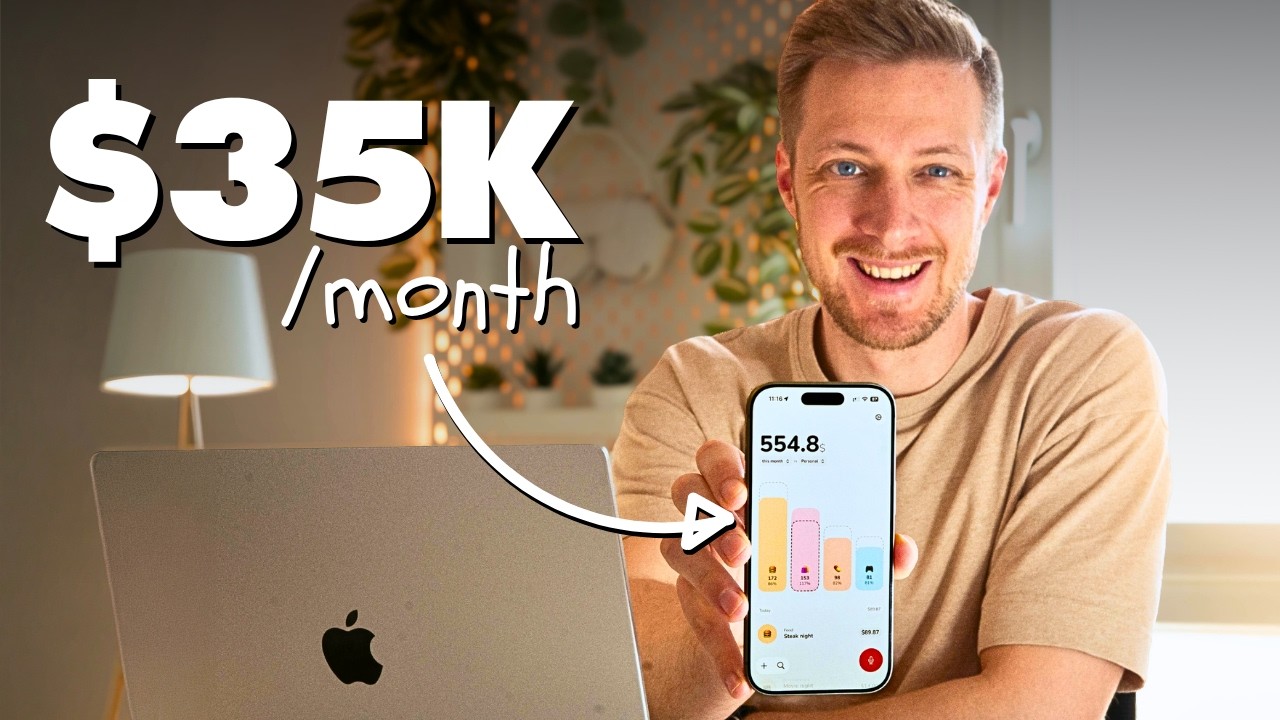
How This App Makes $35K/Month
In this summary (4)
TL;DR
- Flo built Monai, an AI expense tracker, but stagnated at $300 MRR for 1.5 years.
- Partnering with a Colombian influencer on profit-sharing grew revenue to $35K MRR in a year.
- The influencer posts only 3 high-quality, story-driven videos per month.
- Flo's playbook: warm up, reference specific content, connect dots, signal willingness to pay.
- Success shows distribution via a single committed creator can win in crowded markets.
- Looking outside the U.S. market opens new opportunities for solo app developers.
The App That Almost Wasn't
Flo, a solo developer from Germany, built an expense tracking app called Monai for himself. He wanted to solve a personal annoyance: every app he tried was too cumbersome, so he stopped tracking his spending. The idea was simple: use AI to make logging expenses frictionless. Voice input, Apple Pay automation, and an AI that answers questions like "I want to save €300 a month—which cost should I cut?" [15:18]. He shipped the first version in a month or two, a deliberate reaction to a previous project that took two years and launched to silence [03:30]. For a year and a half, Flo did everything alone. He built, he marketed, he posted. The result was $300 in monthly recurring revenue (MRR). Not nothing, but not a living wage either. [02:10]
The Distribution Epiphany
Then an influencer from Colombia, whose content Flo had been following, reached out. He had found Flo's social handles in the app's metadata [04:20]. They negotiated: a profit share plus a fixed monthly retainer. "We noticed percentage of revenue doesn't really scale well," Flo says. Profit-based incentivizes the creator to think about what's best for the app, not just to deliver a video and walk away [05:35]. The influencer posts only three videos per month on his main channel, all story-driven and high quality. The first video, a simple walkthrough, was posted at the end of 2024. Within a week, MRR hit $3,000; within a month, nearly $8,000 [04:30]. A video about Apple inviting them to DUPDC (a developer conference) garnered 1.7 million views and added almost $5,000 to MRR [08:20]. In just over a year, MRR went from $300 to $35,000—a growth of over 10,000%. Flo built a visualization tool to track each video's impact; the small circles on the graph show discrete jumps, each corresponding to a single piece of content [07:20].
The Influencer Playbook
Flo and his partner distilled their approach into a five-step playbook for developers who aren't natural marketers [09:35]. Step one: find aligned partners. Look for creators whose lifestyle, tone, and audience match your product. Flo's partner is not a pure tech reviewer; he mixes tech with lifestyle, so his audience cares about stories and aesthetics, not just specs [10:00]. Step two: warm up the relationship. Follow them, comment genuinely over time. If you don't have time, at least be upfront—don't fake it [10:30]. Step three: be specific in outreach. Reference a particular video, a joke, a moment. "I really liked how you made such a little detail look so cinematic" [11:15]. Step four: connect the dots to your product. Show alignment, not just a transaction. For Monai, the overlap was minimalistic design and AI—a perfect fit for an audience that values aesthetics and tech [11:45]. Step five: acknowledge their value and signal willingness to pay early. Flo suggests saying something like, "I understand the value of what you do. You can reach millions with a single video. I'd love to have you as a long-term partner and share the profits." He adds that naming other apps in the niche that make $50K to $100K per month helps set a future mental model [12:30]. Bonus tips: keep outreach brief, send a personalized video, and add your social handles to your app—this can lead to influencers reaching out to you, which gives you better negotiating power [13:00]. Flo emphasises looking outside the US market; his partner is Colombian, and that opened a whole new audience [13:40].
What It All Costs
Flo built Monai natively using Xcode. His tech stack includes Cloud Code ($100/month), RevenueCat for analytics and A/B testing ($400/month), Appwrite for backend and authentication ($25/month), OpenAI and Anthropic for AI requests ($200/month), and Helm for App Store management (lifetime $175). Design is done in the free tier of Figma [15:00]. The monthly costs total roughly $725, meaning the $35,000 MRR leaves a comfortable margin. Flo's final piece of advice to his younger self: don't be afraid of meta ads. He was intimidated by the idea of wasting money, but using the influencer's high-quality videos as ad creative has already shown promising results [16:55]. The lesson is clear: in a crowded category like expense tracking—where "it's already been done" is the common refrain—distribution is the differentiator. One committed, profit-sharing partner in a non-US market turned a hobby into a full-time business. Flo quit his job earlier this year. He now works on Monai full-time [02:50].